Companies & multi-site networks
Roll out training at scale across your teams
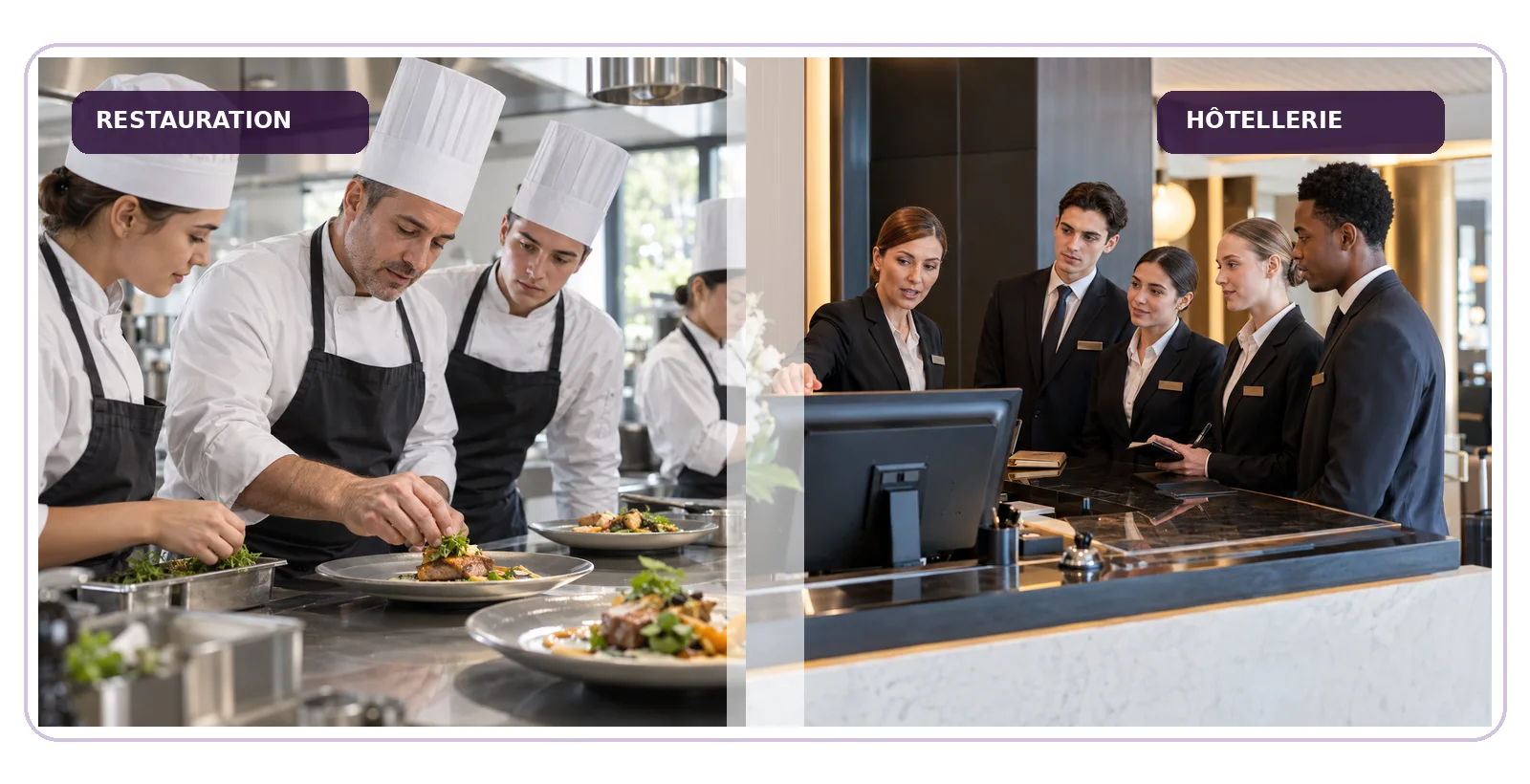
View this use caseIn a restaurant, a hotel or a specialised training centre, Soriston brings training closer to the situations people actually meet: welcome, service, production, hygiene, quality, customer relations and site procedures. The goal: give landmarks before the field and complete existing paths with concrete situations to work on.
Give landmarks on the place, the role and the standards before the first real situation.
Work from scenes, procedures and contexts directly linked to the business.
Kitchen, dining room, reception, housekeeping, management or F&B roles: adapt uses to the job concerned.
Teams have to learn while serving, producing, welcoming guests and handling the unexpected. Some situations are frequent; others are essential but hard to trigger at the right moment for training.
A new employee must quickly understand the premises, the team’s habits and the expected standards.
Order of steps, presentation, guest posture, quality control or opening procedure: small gaps can change the experience.
A guest in difficulty, a complaint, a preparation error or an unusual situation does not necessarily arise when a trainer is available.
New recipe, new offer, new equipment or a change of procedure: teams need shared landmarks.
Soriston fits wherever the job requires observing, finding one’s way, following a procedure, making a decision or adopting the right posture with a guest.
Check-in, special request, guest in difficulty, complaint.
Recipe, mise en place, hot/cold station, equipment, order of steps.
Set-up, order taking, service, coordination and guest posture.
Hand washing, use-by dates/FIFO, cross-contamination, cleaning, checks.
Preparation, room order, checkpoints and handling a deviation.
Briefing, prioritising, checking standards and supporting teams.
When a procedure is only passed on orally, its explanation can vary with the manager, their experience or simply the time they have that day. From one location to another, small gaps can appear.
Soriston presents the same situations, the same expectations and the same points of vigilance to the teams concerned. Every employee starts from a shared reference, while the manager keeps their role to explain the context, answer questions and support practice on the ground.
The same procedures, situations and standards are presented the same way to the teams concerned.
Passing on knowledge depends less on each manager’s availability, experience or way of explaining.
Soriston provides a common base. The manager adds context, debriefs and supports application on the ground.
Before a first day, a first service or starting a new role, the team can already have seen the environment, understood the points of attention and worked on situations representative of the job.
Soriston does not replace support on the ground: it gives landmarks upstream and provides the manager or trainer with a common base to explain, observe and debrief.
The quality perceived by the guest depends on a succession of moves, decisions and coordination. Soriston lets you work on situations suited to each function without reducing hospitality to a single type of job.

Standards take on their full meaning when placed back in context: a guest is waiting, an order changes, a room shows a deviation, a product is no longer compliant or several priorities arise at once.
Link the procedure to a scene, an environment and a situation the team can recognise.
Get people thinking about the right response when several choices are possible or something unexpected happens.
The manager or trainer can use the same situation to explain and debrief with several employees.
When practices change, training can be adjusted or may need new filming depending on changes on the ground.
Prepare a new recruit before their first real situations.
Present the steps, points of attention and standards before the launch.
Work on procedures and control situations in a context close to the field.
Prepare welcome, advice, difficulty or complaint situations.
Give landmarks on a new environment and how it is organised.
Go back over a specific situation when a point needs reworking.
For an apprenticeship centre, a hospitality school or a specialised training centre, Soriston brings paths closer to the situations expected in a real establishment. Learners can discover professional environments, work on shared cases and arrive at their placement or work-study with more landmarks.
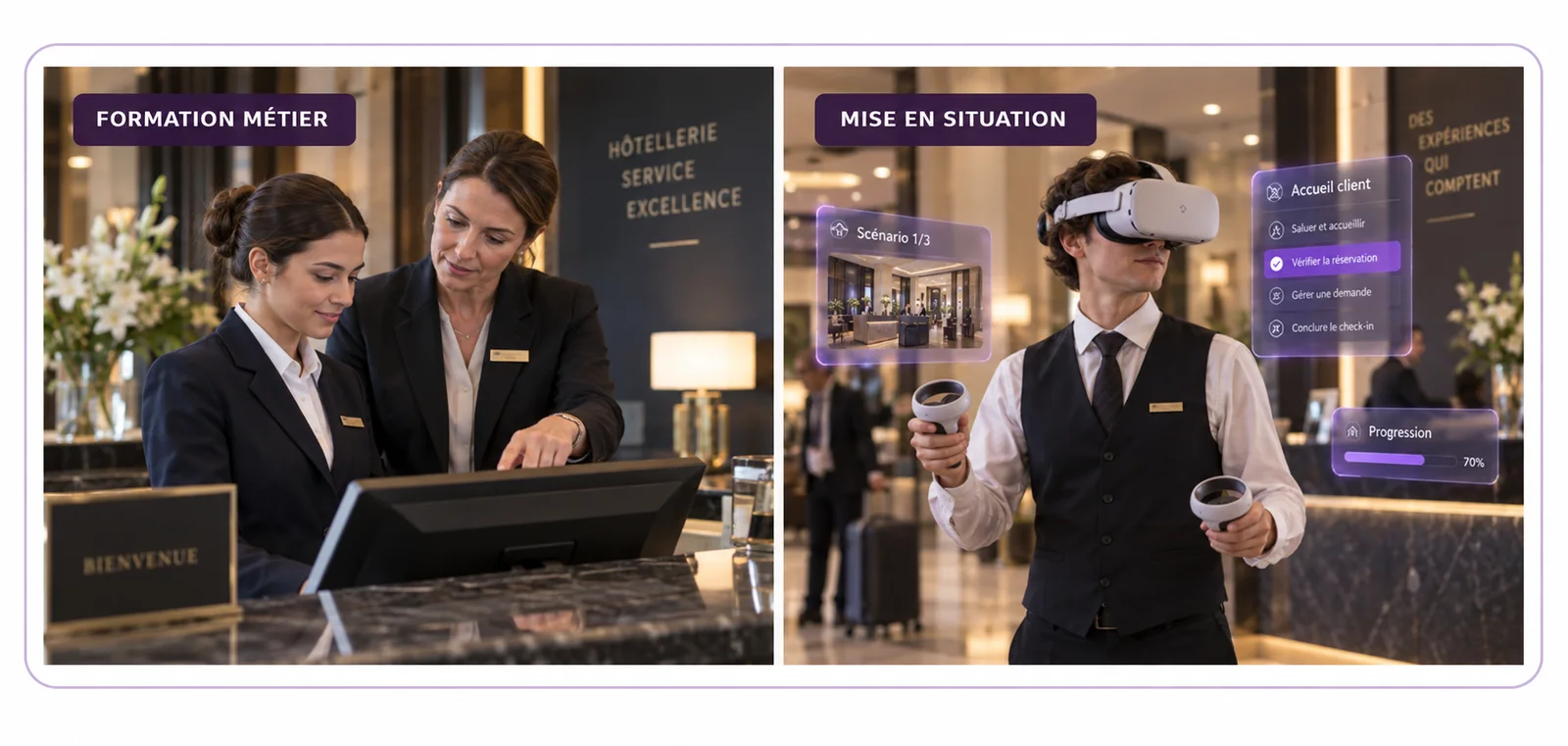
A restaurant or a hotel welcomes a new employee. Before they meet every situation of the job, the establishment uses Soriston to give them landmarks and structure their first discussions with their manager or trainer.
The employee gets familiar with the environment, the useful areas and the main landmarks of their station.
They work on the steps, points of attention and expected behaviours in representative situations.
They observe, choose or carry out the planned actions depending on the type of training and the device used.
The manager or trainer takes up the useful points and continues support in the real situation.
You do not need to transform your whole path at once. A first case can answer a concrete need, then be extended to other jobs or situations once its use is validated.
Start with the onboarding of a job where newcomers need landmarks.
Choose a procedure or practice that must be understood the same way.
Work on an important case that cannot easily be triggered in real conditions.
Use a new product, a new procedure or a new environment as a first use case.
Show us a key moment of your business: welcome, recipe, service, room, quality control or a guest situation. We will show you how Soriston could fit into your organisation and your existing paths.
About 15 min · No commitment · Nothing to install
Yes. Uses depend on the situations to work on: kitchen, dining room, reception, housekeeping, guest relations, quality, management or other operational roles.
No. Depending on the content, Soriston can be used on VR headset, mobile, tablet or desktop.
Yes. Rollout can start with a targeted situation or job before being extended to other uses.
Yes, when the sites genuinely share the same situation or procedure. Adaptation or new filming may be needed if the environment or the standard differs.
Yes. Some elements can be adjusted; new filming may be needed when the environment or the filmed action changes significantly.
Yes. Soriston can complement the paths of an apprenticeship centre, a hospitality school or a specialised centre to prepare learners for concrete professional situations.
Yes. Welcome, advice, a guest in difficulty, complaints or decision-making can be part of the situations worked on, depending on the scenario designed.
No. The data reflects the actions and results observed during Soriston sessions. It supports follow-up and debrief, without replacing observation on the ground.
From the kitchen to the front desk, bring training closer to the situations that really make the job.